Saturday, January 16, 2016

Bighorn Sheep


Last weekend we stopped by SilverRock Resort in La Quinta, for some quick birding at the clubhouse lake.

In addition to the expected usual species - Ring-necked Duck, American Coot, Mallard, Gadwall, American Wigeon, Ruddy Duck, Pied-billed Grebe, Snowy Egret, Ladder-backed Woodpecker, Verdin, Mourning Dove, Yellow-rumped Warblers - we spotted 7 Canvasback (3 males and 4 females).

We also saw two groups of bighorn sheep.

One group of five males was on the opposite side of the pond from us. (The fifth male was off by himself, closer to the base of the mountains.)
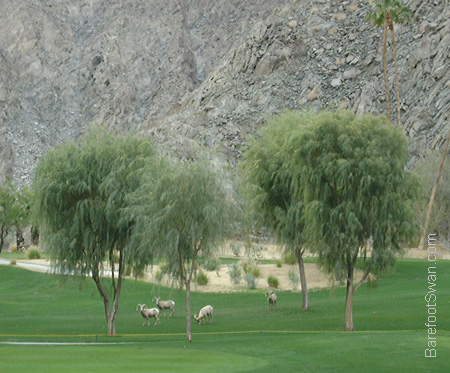


Another group of three crossed the road right in front of us, as we were leaving.


Peninsular Bighorn Sheep (ovis canadensis) live in low elevation areas in our local desert mountain ranges, and populations occur south into Baja California. They were listed as a federally endangered species in 1998.

Bighorn sheep are greatly affected by habitat loss and fragmentation, caused by commercial development within their historic range. Natural factors include predation on an already reduced population, lamb mortality, and disease. In urban areas they additionally encounter dangers such as automobiles, poisonous landscape plants, and swimming pools. And in their native habitat research is being done on the presence of humans and dogs on hiking trails, and how that may disrupt bighorn sheep from historic lambing areas and watering holes.

Although it was exciting to see these sheep so close, they definitely do not belong on golf courses. Grass is not a part of their diet and eating it exposes them to pesticides, fertilizer and other chemicals. They are at high risk from predation as they get further away from their steep mountain escape terrain. And exposure to humans makes them less wary, which is also detrimental to their survival.

The Bighorn Institute in Palm Desert, CA is dedicated to investigating and researching the decline of bighorn sheep populations, both locally and world-wide. In addition to their research and treatment of sick wild sheep, they also maintain a captive-rearing and wild release program that has been extremely important in expanding our local bighorn sheep population.


Bighorn Institute website:
http://www.bighorninstitute.org/index.html

For info about proposed fencing for the bighorn at SilverRock resort:
http://www.bighorninstitute.org/newsletter.html


Saturday, January 9, 2016

El Niño Has Arrived


The El Niño weather pattern has started to bring some much-needed rain to California over the past week. We received more than an inch of rain here in the desert, from three separate storms.

The surrounding mountains received a coating of snow. This is Mt. San Jacinto to the west of us (elevation 10,834').


The rains were steady and gentle, and much of it soaked into the soil. The Whitewater Wash had some runoff for about a day (below). This is looking north, towards Joshua Tree National Park. In the center of this pic you can just see snow on the mountains along the south edge of the Park.

There were Killdeer calling and running along the edge of the water while I took this photo. Probably glad to find a new bit of habitat, even if it's only temporary.


After the last storm moved through, we were gifted with clear blue skies, beautiful snowy mountain views - and overnight lows in the high 30's.


"I have never seen snow, and do not know what winter means."

~ Duke Kahanamokou, native Hawaiian and U.S. Olympic swimmer, credited with bringing surfing to the mainland and Australia.


Saturday, October 17, 2015

Desert Garden Community Day


Today we attended the 10th Annual Desert Garden Community Day, sponsored by our local Desert Horticultural Society. The event was held at the Living Desert Zoo and Botanical Gardens in Palm Desert.

The Desert Horticultural Society of the Coachella valley was founded in 2005 to "promote the use of desert appropriate plants that support local wildlife and conserve water".


With the increasing fragmentation of local desert habitat and our ongoing drought, these goals are especially important and timely.


The event brought together various non-profit groups, government agencies, educational facilities, local conservation projects and businesses that promote native plants, water conservation and drought tolerant landscape concepts.


There were also a number of free classes offered with topics covering lawn removal or reduction, proper pruning techniques, growing vegetables in the desert, plant propagation, the Monarch Project at Sunnylands, desert landscape design and water conservation among others.

After talking with the many exhibitors and taking a couple of the classes, we headed over to the Butterfly Garden to get some new plant and landscape design ideas for our yard.

The Butterfly Garden is beautifully landscaped with a variety of plants that provide food for caterpillars, nectar for the adult butterflies, and host plants for butterflies to lay their eggs on. There are also basking rocks for sunning, and mud areas for puddling.


The plants are labelled with common and scientific names, and many are for sale in the Living Desert's nursery.


The nursery also sells many other desert native and drought-tolerant plants as well as yard art, ceramic pots, and a good selection of books about desert gardening.


Desert Garden Community Day was a great opportunity for the public to learn about native plants and the work that these participating groups are doing to promote them. Big thanks to the staff and volunteers who made this informative and interesting event possible.


For more info:

DESERT HORTICULTURAL SOCIETY
www.deserthorticulturalsociety.org

THE LIVING DESERT
www.livingdesert.org

CALIFORNIA NATIVE PLANT SOCIETY
http://riverside-sanbernardino.cnps.org/

SUNNYLANDS MONARCH PROJECT
http://sunnylands.org/news/view/762

FRIENDS OF THE DESERT MOUNTAINS
http://www.desertmountains.org/


>> Use the magic of Google to find similar types of organizations and events in your area!


Friday, October 16, 2015

A Little Rain...


When you live in the desert a little rain can be a big deal. In addition to the much-needed precipitation, another benefit is the amazing sunrises and sunsets that often accompany the rain clouds.

Here are a few pics from our early morning walks over the last few days. Kind of makes you feel sorry for the people who slept in and missed these...

Colors courtesy of the Supreme Creator, no Photoshop needed.
Thank you, God. Nice work :-)


"What is the good of your stars and trees, your sunrise and the wind,
if they do not enter into our daily lives?"

~ E. M. Forster  (English novelist, 1870-1970)


Friday, October 2, 2015

Lunar Eclipse - 27 Sept 2015


This total lunar eclipse on Sunday 27 Sept was special for a couple of reasons.

First, it occurred during a "super moon", which is when the moon appears slightly larger in the sky due to its relative closeness to earth in its elliptical orbit.

Second, it is the final lunar eclipse of a tetrad - a series of 4 total lunar eclipses occurring 6 lunar-months apart.

Third, it was easy to see because here on the west coast it began just after sunset. So no need to set the alarm to wake up at "what-the-heck-were-we-thinking" o'clock and wander outside to view while half asleep.

And finally, we had a convenient viewing spot with an unobstructed east horizon, less than a mile from our house.

All pics  were taken while holding our digital camera to the eyepiece of our 25x  field scope.


The moon rose already in partial eclipse. We soon noticed that there were some thin low clouds on the horizon. They created a band-like appearance across the face of the moon.


As the eclipse progressed we could notice the moon began to take on a reddish color. This is caused by the  sun's light passing through the earth's atmosphere on its way to the moon.


The redness became more pronounced as the moon passed deeper through the earth's shadow.


Saturday, September 26, 2015

Paradise Lost

Our project this weekend was to clean out a pile of mesquite wood we had stacked in the back corner of our yard. The tarp and plastic covering the wood was breaking apart under the desert heat and sun, and long strands of bermuda grass were growing all over the pile and covering it up.

As we started to unstack the wood and move the logs aside, we were expecting an exodus of black widows, centipedes, scorpions and other critters that enjoy living in quiet, dark undisturbed places. Surprisingly, we only saw a few crickets and cockroaches but nothing like we had anticipated. We dug out the bermuda grass as the wood pile got smaller.

We finally cleared the stack and lifted up a pallet that had become partially buried below the pile of wood. Suddenly there was some movement and 2 large geckos bailed out from under the pallet, clinging to the block wall a few feet above the ground.

We v-e-r-y carefully put the pallet back down to figure out how to proceed. The geckos crawled back down to the pallet.

The geckos' home was basically gone. We had unknowingly cleared away their habitat. We had no idea how many more might be living there.

Our plan had been to do this project over a couple of days, but that would leave the geckos with no place to be safe from predatory birds and stray cats.


After thinking of a couple of options, we decided to temporarily recreate the habitat on our lot, directly adjacent to the other side of our wood fence.

We left the pallets in place, and dug an escape route for the geckos under the fence. The plan was to relocate the pallets one at a time, then restack the wood on top.

The new location on the other side of the fence was prepared. We carefully lifted the pallet again and this time 3 geckos appeared. Two immediately raced for cover behind the pool control box mounted a few feet away on the block wall. The third dashed in the opposite direction.

We waited a bit in case any other geckos were going to appear. There was no other movement so we moved the pallet to the new location and restacked the wood.

We finished carefully cleaning out the debris and bermuda grass where the pallet had been, and found one more smaller gecko.

We gently herded the little gecko to the gap under the fence and it zipped through to safety under the new wood pile.

One of the challenges of creating a backyard habitat is the possible consequences when changes are made. Raking leaves removes cover for lizards and beneficial insects. Trimming bushes may destroy butterfly chrysalises or praying mantis egg cases. Clearing away spider webs takes away hummingbird nesting material. Pesticides can kill not only the target "nuisance" insects but beneficials as well.


"When we try to pick out anything by itself, we find it hitched to evereything else in the Universe."  ~John Muir, My First Summer in the Sierra


Red Racer!


The geckos weren't the only ones to have their habitat disrupted by our clean-up. We found this gorgeous snake - a Red Racer - about a half hour after we thought we had finished in that corner of our yard.

Red Racer had only come out partially from under the storage box, but we could see he was a good size snake. About 2 feet of the body was visible, and it did not show any signs of tapering down to its tail.


He stopped with his head raised and occasionally tasted the air with his tongue, probably trying to figure out what had happened to his home.


Red Racers get their common name from their beautiful coloration, and their ability to move very rapidly. They can grow to be very large - to 6 feet in length or more.

Individual snakes can vary greatly in appearance and their coloring may be shades of pink and red, light brown or tan. They have large eyes and most have darker patterns on the head.


Red Racer is a diurnal snake, which means it is out and about during the day. It is an active hunter, eating whatever it can overcome and crush with its jaws. This may include lizards and other snakes, birds and road kill. It can climb into bushes and trees so nestling birds and bird eggs can also be part of the diet.

Although Red Racer is not poisonous, it will defend itself by striking or biting if threatened or handled.


We didn't want to scare him so we stepped away. He came out a bit further from under the storage box, and moved towards the pool control box on the wall where two of the geckos had hidden themselves earlier. Red Racer started to crawl upwards along the wall, then made a fast lunge towards the box. One of the geckos zipped out from behind, dashed across the block wall, and disappeared behind the bamboo fencing a few feet away.

We figured our Red Racer had had a challenging enough day so far, so we left him in peace while we figured out how to reconstruct his habitat.

This is a new snake species for our yard, and brings our yard list snake species total to 5: Red Racer, Desert Blind Snake, Shovel Nose Snake, Black-headed Snake, and Gopher Snake. It is amazing that our yard can support a snake this size, and even more surprising that it has obviously been living here for a while.

We will be rethinking our plans for this corner of the yard, to make sure he has a safe place to live.