Monday, March 30, 2015

Baby (Hummer) Pics


We continue watching the hummingbird nest on our back patio, using the field scope set up in our kitchen.

Right after the eggs hatched, mom hummer appeared fidgety when sitting on the nest.

Probably because she was now sitting on 2 wiggly babies instead of 2 eggs.


Mom hummer was staying busy, constantly making forays out into the yard to gather insects and nectar, then returning to the nest to quickly feed her babies.


We also noticed that the babies had started pooping over the side of the nest.

Every now and then we would see a tiny bare-naked hummingbird butt appear above the edge of the nest, and proceed with the projectile pooping.

This is a natural behavior, which helps keep things cleaner inside the nest.


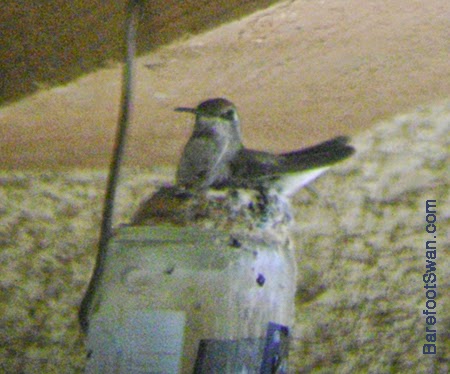
It took a while before we could get a picture of mom and her babies together.

They were so small we couldn't see them above the edge of the nest unless they were feeding (or pooping).

And her feeding stops were surprisingly brief and efficient.


With patience, we were finally able to get a baby pic just as mom left the nest after a feeding. One is easily seen, with its short little beak and big eyes.


"Any glimpse into the life of an animal quickens our own and makes it so much the larger and better in every way."
~ John Muir; Author, naturalist and wilderness advocate (1838-1940)


Friday, March 27, 2015

A Little Help, Here...


A couple of days after we found orange aphids on our Milkweed, we had a ladybug show up on one of the flower heads.


Ladybugs are natural predators of aphids and other soft-bodied insect pests. A single ladybug can eat up to 50 aphids per day!


Ladybugs go through 4 steps in their life cycle. Female Ladybugs lay their eggs on the underside of leaves, or in other hidden and protected areas. The eggs hatch into larvae that look like a black and orange miniature crocodile.

The larva starts eating, and will shed its skin a number of times as it grows. The larvae will eventually pupate and finally hatch out to become the ladybug beetle we all recognize.

We are hoping s/he brings more friends to dine on the aphids.
There are plenty to go around...


"Hurt no living thing:
Ladybird, nor butterfly,
Nor moth with dusty wing..."
~ Christina Georgina Rosetti, British poet and lyricist (1830-1894)


For more information about Lady bugs:


Friday, March 20, 2015

Hummingbird Babies!


We are proud to announce the arrival of twins.
They hatched early this morning (Friday).
Mom hummer and her babies are all doing fine.
She is working continuously to keep them fed and protected in their nest.

Approximate size of a baby hummingbird:
-- Length - about an inch
-- Weight - a little over half a gram (3 baby hummers = the weight of one US dime)

For 2-1/2 weeks we have been using the field scope set up in our dining room, to watch mom hummer sitting on the nest. This morning for the first time we saw her perched on the edge of the nest, as she fed each baby in turn. Her head bobs up and down in a sewing machine-like motion as she transfers the pre-digested food into their gaping mouths. After each feeding she settles back in to the nest to keep the babies warm. The babies are very tiny now, and their naked heads barely show above the edge of the nest as they are feeding.

Hummingbird babies need protein to grow - they cannot survive on just nectar or hummingbird food. The food that mom hummer regurgitates for them includes small insects that she catches in flight. We see her in the backyard zig-zagging through the air as she chases their next meal, or searches plants and spider webs for insects.


This is an excellent information source, for everything you could want to know about hummingbirds:
http://www.worldofhummingbirds.com


Thursday, March 19, 2015

Elsewhere in the Garden...


The solitary bees started hatching out of our bee-obelisk this past weekend, as daytime temperatures reached the low 90's. Recent cool weather since then has slowed them down a bit, but that will be changing soon.


Two days ago we found three new Queen Butterfly caterpillars on the Desert Milkweed in our courtyard. Looks like we will have another round of butterflies in a couple of weeks.


There was a flock of about 20 Cedar Waxwings perched in our tallest mesquite tree yesterday morning.

Off by itself in a lower branch of the same tree was a single Western Kingbird, the first one we have seen this season.


What we originally hoped were orange butterfly eggs on the milkweed plant are actually orange aphids.

Rather than using pesticides, we'll clip and remove the affected stems if it looks like the aphids are getting out of control.


There are at least 2 verdin nests in our mesquite trees. Mockingbirds likely have a nest in one of the other mesquites. They have been extremely temperamental, territorial, and vocal - even more so than usual.

The palo verde tree is starting to produce buds and will soon be covered in yellow flowers.


"Nature will bear the closest inspection. She invites us to lay our eye level with her smallest leaf, and take an insect view of its plain."
~ Henry David Thoreau


Wednesday, March 18, 2015

Any Day Now....


The female hummingbird continues sitting on the two eggs in her nest, on top of the hummingbird feeder. She makes quick forays out for food, or to chase away other birds that are coming too close. Sometimes she'll take a brief sunbath on a nearby perch, but she is never away from the nest for very long.

A potted aloe right below her nest is blooming now, and she has added its yellow tubular flowers as a convenient feeding stop. Her eggs should be hatching soon and we have been watching discretely through the kitchen window. The scope in the dining room is working well, and the pic above was taken with a camera hand held to the eyepiece.


In the front yard, our agave flower stalk is now over 10-1/2 feet tall.


We have selectively trimmed branches from the nearby palo verde tree (three times!), to make room for the stalk as it kept getting taller.


Today we staked the stalk, to lean it away from the canopy of the palo verde.


It's hard to see from the ground, but the flowers at the tip of the stalk are just beginning to show.


"One of the most delightful things about a garden is the anticipation it provides."
~ W. E. Johns, English aviator, author and editor (1893-1968)


Tuesday, March 17, 2015

St. Patrick's Day


Happy St. Patrick's Day!

St. Patrick is one of the patron saints of Ireland, but he was actually of Romano-British descent. His name was originally Maewin Succat and he lived in Britain during the 5th century AD. As a teenager, he was captured by pirates and taken to Ireland where he was forced to work as a slave tending sheep for many years.

Eventually he escaped from Ireland and returned to his home and family in Britain. The many years spent praying in captivity brought him to the priesthood, and he took the name Patrick when he was ordained. Years later he became a bishop, and was sent to Ireland as a missionary. There he used his knowledge of the language and customs to establish churches and convert heathens to Christianity.


Shamrocks are associated with St Patrick because he is purported to have used them as a way to explain the concept of the Holy Trinity (Father, Son, Holy Spirit) to potential Christian converts.

Another legend about St Patrick is that he drove all the snakes out of Ireland. There are no fossil records of snakes in Ireland, so it is more likely that glaciers and cold weather kept snakes away.

March 17th is the day of St Patrick's death.


"I prayed in the woods and on the mountain, even before dawn. I felt no hurt from the snow or ice or rain."
~ from the writings of St. Patrick


Saturday, March 14, 2015

A New Butterfly Visitor


We added a new butterfly species to our yard list this morning.

It was flitting around our red lantana bushes, and sipping nectar from the colorful flowers.

The butterfly was very active - constantly moving and fluttering its wings. It did not alight to sip the nectar, but hovered as it dined.


The butterfly was rather large, with mostly black wings that had rows of yellow spots in bold diagonal bands. Fortunately we had the camera with us, so we could take pictures and consult our Butterfly Guide.

It was a Giant Swallowtail Butterfly, Papilio cresphontes.


This beautiful Butterfly is found throughout most of North America, except for the northwest.

They may also range into Central America, parts of the Caribbean, and into southeastern Canada.

Its wingspan can reach up to 6" from tip to tip, making it the largest butterfly in the U.S. and Canada. The large wings give Giant Swallowtail a very strong flight and the ability to glide long distances.


The female Giant Swallowtail lays her orange-colored eggs singly on the selected host plant. About 12 days later the caterpillars hatch out, eating the remains of their egg casing and then heading out in search of food.

The young brown and white caterpillars look like bird droppings, and this camouflage helps protect them from predators. The chrysalis is a very plain mottled brown and looks like a broken twig.

The caterpillars are considered pests in many commercial citrus orchards, where they are referred to as "Orange Dogs". The hungry caterpillars can defoliate potted plants or small trees, damaging the plants and causing reduced crop yield. Providing suitable host plants in your yard can help these butterflies find a safe place to lay their eggs and ensure their offspring have enough to eat. These host plants include the citrus family for laying eggs and caterpillar food (orange, grapefruit, etc.); and lantana and bougainvillea for nectar.


To learn more about the Giant Swallowtail
http://entnemdept.ufl.edu/creatures/citrus/giantswallowtail.htm
http://www.butterfliesandmoths.org/species/Papilio-cresphontes

For general butterfly facts and info:
http://www.butterflyfunfacts.com/

To purchase butterfly host plants, butterfly life cycle kits, chrysalises and more
visit the Shady Oak Butterfly Farm:
http://www.butterfliesetc.com/