Saturday, September 26, 2015

Red Racer!


The geckos weren't the only ones to have their habitat disrupted by our clean-up. We found this gorgeous snake - a Red Racer - about a half hour after we thought we had finished in that corner of our yard.

Red Racer had only come out partially from under the storage box, but we could see he was a good size snake. About 2 feet of the body was visible, and it did not show any signs of tapering down to its tail.


He stopped with his head raised and occasionally tasted the air with his tongue, probably trying to figure out what had happened to his home.


Red Racers get their common name from their beautiful coloration, and their ability to move very rapidly. They can grow to be very large - to 6 feet in length or more.

Individual snakes can vary greatly in appearance and their coloring may be shades of pink and red, light brown or tan. They have large eyes and most have darker patterns on the head.


Red Racer is a diurnal snake, which means it is out and about during the day. It is an active hunter, eating whatever it can overcome and crush with its jaws. This may include lizards and other snakes, birds and road kill. It can climb into bushes and trees so nestling birds and bird eggs can also be part of the diet.

Although Red Racer is not poisonous, it will defend itself by striking or biting if threatened or handled.


We didn't want to scare him so we stepped away. He came out a bit further from under the storage box, and moved towards the pool control box on the wall where two of the geckos had hidden themselves earlier. Red Racer started to crawl upwards along the wall, then made a fast lunge towards the box. One of the geckos zipped out from behind, dashed across the block wall, and disappeared behind the bamboo fencing a few feet away.

We figured our Red Racer had had a challenging enough day so far, so we left him in peace while we figured out how to reconstruct his habitat.

This is a new snake species for our yard, and brings our yard list snake species total to 5: Red Racer, Desert Blind Snake, Shovel Nose Snake, Black-headed Snake, and Gopher Snake. It is amazing that our yard can support a snake this size, and even more surprising that it has obviously been living here for a while.

We will be rethinking our plans for this corner of the yard, to make sure he has a safe place to live.

Saturday, April 11, 2015

First Flight


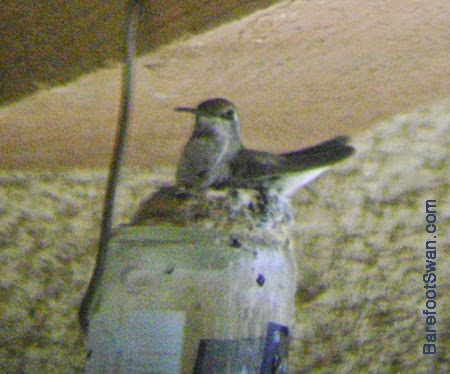
The hummingbird babies left their nest on Thursday 9 April, 21 days after hatching.

The two of them had gotten so big that they no longer fit in the nest.

They were constantly moving about, fluttering their wings, and generally looking ready to go.


Mom Hummer continued to feed them, but also spent a lot of time hovering and circling next to the nest. It looked like she was demonstrating and encouraging them to fly.


While she was gone, the babies kept fluttering and cautiously trying out their wings in the safety of their nest.

We saw one perch on the edge of the nest and briefly lift off for a few seconds before landing back in the nest.

They kept fluttering and hovering briefly, then landing before trying it again.


And eventually, one of the times we checked back, they were both gone.

We soon saw them both at the nearby hummingbird feeder.


They were easily recognized by their smaller size and relatively shorter beaks in comparison to the adult hummers that also frequent the same feeder.


The two youngsters appeared to be staying close together - coming to the feeder at the same time or within just a few seconds of each other. Mom Hummer kept a close eye on them, hovering nearby and dive bombing any bird that looked like it might threaten her babies.

Good luck, little guys.
Have a good life. :-)  :-)


"Once you have tasted flight, you will forever walk the earth with your eyes turned skyward, for there you have been, and there you will always long to return."
~ Leonardo  da Vinci


Tuesday, April 7, 2015

Stretching Their Wings


The hummer babies are about 19 days old, and have grown quickly in size.

A little while ago we could only see them when they lifted their tiny heads for Mom to feed them.

Now we can see them from across the patio.


They are very aware of their surroundings and turn their heads constantly as they look all around.


There is a lot of fidgeting and jostling going on as they shift position, and stretch and flutter their wings.

They are moving around a lot, and the sides of the nest are starting to get flattened.

Sometimes Mom Hummer has a hard time trying to find an edge to perch on when she feeds them.


We also noticed Mom is changing her behavior. She is extremely aggressive at the nearby hummingbird feeder, chasing away other birds.

A couple of days ago we saw her chase a male Costa's hummer under a patio chair, and keep him cornered there for a couple of seconds.

Yesterday she chased a Verdin off the feeder and into a nearby hanging spider plant.


Mom Hummer is also spending more time hovering around the nest, instead of flying directly to it and perching right away. Maybe she is encouraging the babies to fly? They flutter their wings in response to her behavior.


"If you were born without wings, do nothing to keep them from growing."
~ Coco Chanel


Saturday, April 4, 2015

Lunar Eclipse - 4 April 2015


Here are some pics of this morning's lunar eclipse.
These were taken with a digital camera hand-held to the eyepiece of our 25x field scope.


We got up around 4:15am, and the eclipse was already in progress.


The high contrast of the moon's bright surface against the dark sky blew out most of the earliest shots of the eclipse.


During this eclipse, the moon was just skimming through the outer portion of the earth's shadow, so the time of totality was very brief - only about 5 minutes.

Here in California, totality occurred just before 5am PDT.


The partially eclipsed moon eventually set behind the mountains to the west of us, so we couldn't see the end of the eclipse from our location.

This was a pretty cool way to start the day.
:-)  :-)


The next lunar eclipse visible from North America will be on 28 September 2015.
For more info about that and other future eclipses:

http://www.timeanddate.com/eclipse/lunar/2015-september-28


Wednesday, April 1, 2015

Insert. Food. Here.


The hummingbird babies are about 11 days old now, by our best guess.

Because of the overhead location of the nest, we have to estimate the approximate hatch day based on when we first saw Mom Hummer's baby feeding behavior.

Mom is working from before sunrise until after sunset to keep her babies fed. They are eating machines.


The babies are generally pretty calm while mom is away. They sit very still in the nest with their little beaks pointed upwards, waiting for their next meal.


When mom arrives, they start begging and gaping.

Mom is really good about feeding them both; we can see her moving side to side so they each get their turn.

The babies are most active right after she leaves. Their eyes are open now and occasionally they peek out at the world over the edge of the nest.


Their beaks are getting longer and looking more like a hummingbird.  Tiny little body and wing feathers have appeared, and we saw one of the babies make some tentative wing flapping motions.

Sometimes the babies are fidgety, and the nest stretches and gets a bit misshapen as they jostle about. They both still fit inside the nest, but mom hummer has not sat on the nest with them for a number of days.

This is one of the babies, right after mom finished a feeding.


"Liberty, when it begins to take root, is a plant of rapid growth.
~ George Washington


Monday, March 30, 2015

Baby (Hummer) Pics


We continue watching the hummingbird nest on our back patio, using the field scope set up in our kitchen.

Right after the eggs hatched, mom hummer appeared fidgety when sitting on the nest.

Probably because she was now sitting on 2 wiggly babies instead of 2 eggs.


Mom hummer was staying busy, constantly making forays out into the yard to gather insects and nectar, then returning to the nest to quickly feed her babies.


We also noticed that the babies had started pooping over the side of the nest.

Every now and then we would see a tiny bare-naked hummingbird butt appear above the edge of the nest, and proceed with the projectile pooping.

This is a natural behavior, which helps keep things cleaner inside the nest.


It took a while before we could get a picture of mom and her babies together.

They were so small we couldn't see them above the edge of the nest unless they were feeding (or pooping).

And her feeding stops were surprisingly brief and efficient.


With patience, we were finally able to get a baby pic just as mom left the nest after a feeding. One is easily seen, with its short little beak and big eyes.


"Any glimpse into the life of an animal quickens our own and makes it so much the larger and better in every way."
~ John Muir; Author, naturalist and wilderness advocate (1838-1940)