Wednesday, March 4, 2015

Location, Location, Location


A female hummingbird has built her little nest on our back patio.

She placed it on top of one of our hummingbird feeders, which is tucked up high under the eave of our patio cover.

We obviously won't be filling that feeder for a while...


The nest is right outside our bedroom window.

We took some pics when she had her back to us.


She finished her nest over the weekend - bringing bits of spiderweb and fluff, and carefully placing each beakful inside. She then shaped it by turning in circles inside the nest.

A few days later when she was off-nest, we very quickly checked the nest with a mirror held overhead and saw there were 2 tiny little eggs inside.

We decided to set up our field scope inside the house, in our kitchen. Lately we have been watching her through the opposite window on the other end of the patio.


At first we thought this was a strange place to build a nest.
Besides the obvious (on top of a hummingbird feeder? Really?) it is a high traffic area that we walk past a couple times each day. Since we noticed her there, we have been walking all the way around on the far side of the pool, to give her some space.

But she actually made a pretty smart choice.
-- The nest is protected on 2 sides by nearby walls, and above by the roof.
-- She is sheltered from the elements. She stayed dry during the last rain. And after the rainstorm came through, we had some gusty winds that gave her a bit of a ride on the hanging feeder. But nothing like it would have been on an unprotected tree branch.
-- It is close to a food source. There is another hummingbird feeder about 15 feet away. She allows other hummers in the yard to use it, but when she comes over to feed she is pretty territorial.
-- She has a good view of both the hummingbird feeder and her favorite off-nest perches.
-- It gets morning sun, but is protected from the afternoon sun.
-- The walls and roof hold residual heat, to keep her a little warmer at night.

It will be interesting to watch our smarty-pants hummer as she raises her babies.


"The woods hold not such another Gem
as the nest of a hummingbird.
The finding of one is an event."

~ John Burroughs (1837-1921), American nature essayist and naturalist


Sunday, March 1, 2015

A Little More Rain


Another storm brought light showers throughout the day today.


"I am sure it is a great mistake always to know enough to go in when it rains. One may keep snug and dry by such knowledge, but one misses a world of loveliness."
 ~Adeline Knapp


Friday, February 27, 2015

Waking from a Dream


For the past week and a half we have been searching our courtyard, looking for chrysalises of Monarch and Queen Butterflies. We figured they would be hatching soon, based on the timing of the chrysalis we found in our courtyard last year (which hatched 10-12 days after the caterpillars disappeared).


Yesterday afternoon (Thursday) we found one chrysalis - on the underside of our patio cover, in plain view right over our heads. It had already changed color from lime green to blue, so we knew it would be hatching soon.

We moved a nearby hummingbird feeder away from the chrysalis so the hummers, finches, woodpecker and oriole wouldn't bother the soon-to-hatch butterfly.


By Friday morning the chrysalis had turned black. We knew the butterfly was getting ready to emerge so we checked it obsessively every 15-20 minutes.

We could just see the butterfly inside the chrysalis.


It didn't take long for the actual hatching process. At 10:25am we had a black chrysalis. When we checked back at 10:45am the butterfly had completely emerged from the chrysalis.


We sat on the porch under the Butterfly, enjoying the spring morning and watching as it occasionally made some tentative side-to-side stretches and slight wing flexes.

At times it would unfurl its proboscis, but it mostly sat quiet and motionless as its wings became stronger.

About 2-1/4 hours after emerging from its chrysalis, the Butterfly started doing full wing flexes. A half hour later, it took its first flight.


That first flight was pretty short: straight down.

It managed to land on its feet, and immediately started crawling up the step ladder we had been using to take these pictures.

After a few minutes resting on the ladder it took flight again, this time to the palo verde tree.

It rested again, sitting quietly in the sun.


The next short flight took it over to our Sweet Acacia tree where it again basked in the sun.


Finally it flew up high into the top of the Desert Willow tree.


It was amazing to watch this butterfly emerge from the chrysalis and begin its new life as a winged creature.

The process of metamorphosis - from caterpillar to a butterfly - is truly incredible.

How in the world do all those parts get rearranged? And what goes through the former caterpillar's mind when it wakes up transformed???


This butterfly will only live a few weeks. During that short time it will hopefully avoid cold weather, birds, predatory insects, rain, strong winds, spider webs, car windshields, insecticides and kids with butterfly nets. It will need to find shelter, nectar plants, mud puddles - and a mate - as well as a safe place to lay eggs so the next generation of caterpillars will have enough food when they hatch.

Backyard habitats make an important contribution to the survival of these and many other creatures. They create safe havens that also act as stepping stones between fragmented natural habitats. Something as simple as planting a milkweed plant can make a difference.


“Once upon a time, I dreamt I was a butterfly, fluttering hither and thither, to all intents and purposes a butterfly. I was conscious only of my happiness as a butterfly, unaware that I was myself. Soon I awaked, and there I was, veritably myself again. Now I do not know whether I was then a man dreaming I was a butterfly, or whether I am now a butterfly, dreaming I am a man.”

~ Zhuangzi, Butterfly as Companion: Meditations on the FIrst Three Chapters of the Chuang-Tzu


Monday, February 23, 2015

A Little Rain


We had some light rain last night. Dropped our daytime temperature back down into the 60's.

Lots of birds activity on our morning walk - Bewick's Wren, Northern Mockingbird, Verdin (pair), Abert's Towhee, American Kestrel (pair), Mourning Dove, Eurasian Collared-dove, Great-tailed Grackle, Rock Pigeon, Black Phoebe, Say's Phoebe, Anna's Hummingbird, Ladder-backed Woodpecker, Common Raven (pair), House Finches.

White-crowned Sparrows are still lingering here. When they head north we'll know the summer weather is getting close.


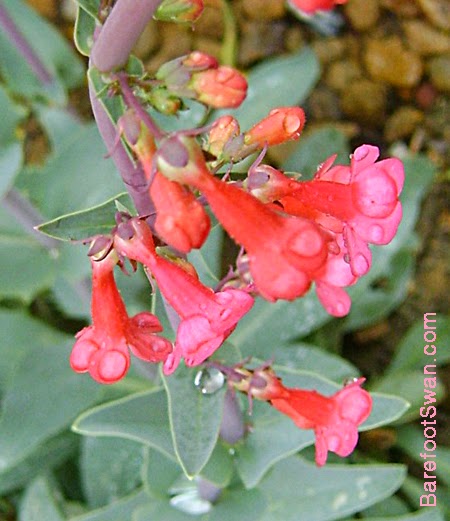
The rain will help our Butterflyweed recover from its recent munching by the Monarch and Queen butterfly caterpillars.

The plant is already putting out new leaves after being thoroughly decimated a week ago.

We saw some Queen Butterflies on our other Milkweed plant a couple of days ago. If they laid eggs, we should have another round of ravenous caterpillars soon.


"When I was a kid, being outside was the norm. Rain or shine, our parents would tell us to get out of the house."
~ David Suzuki

Sunday, February 22, 2015

Reach for the Sky


The agave flower stalk is still growing like crazy.


Mid-week it was 66 inches high, from base of the plant to the tip.


This afternoon it measured 80 inches tall - over 6-1/2 feet!


It has grown more than  4 feet in 7 days, or nearly 7 inches a day.


We had to trim the palo verde tree branches above the flower stalk, to give it room to continue growing.


"Reach for it. Push yourself as far as you can."
~ Christa McAuliffe


Monday, February 16, 2015

And Then There Were None...

The Monarch and Queen caterpillars have all vanished - the last we saw any of them was Sunday 2/15. We have checked the milkweed and butterflyweed plants, and tried to find them inside the yellow chuparosa bush.

If they have already transformed into their chrysalis stage, they are so well camouflaged that they will be extremely difficult to find. The only reason we found the chrysalis last year was because we saw a caterpillar on the bush just as it started to change. Even knowing its location, it blended in so well with its surroundings that it was difficult to re-find each time.

So somewhere in our yard we (hopefully) have at least 22 caterpillars dreaming about flying. If the timing is the same as last year, they should be hatching in about 10-12 days.


"Flying dreams mean that you're doing the right thing with your life."
~Douglas Coupland


Sunday, February 15, 2015

Desert Agave

Our yard landscaping design is pretty informal. Nearly all of the plants are desert native. Some have been purchased but many more are rescues, or volunteers that appeared on their own or have reseeded from existing plants.

One of our plants is a native Desert Agave (Agave deserti) that we rescued many years ago from a construction site. It had been bulldozed off an area of cleared land, and left in a pile of debris destined for the dump.


We brought it home, trimmed the damaged leaves, potted it and nursed it back to health.


Eventually it recovered and we planted it in our front yard, where it has flourished and produced many sucker babies from the base rosette.


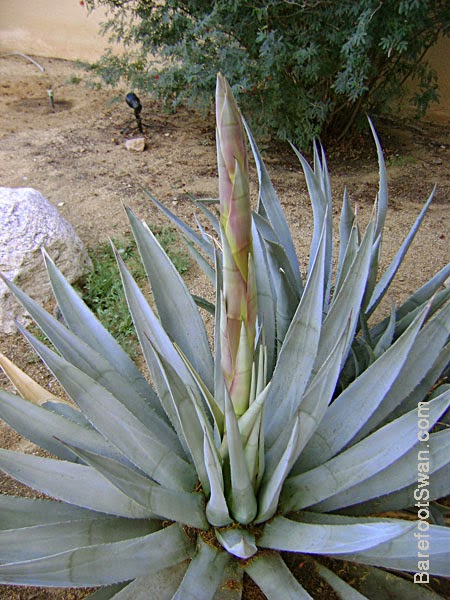
Within the last few days the main plant has started to produce a flower stalk. The stalk is presently about a foot taller than the plant, but it is growing in height rather quickly.


Various species of agave grow throughout the desert southwest. They have historically been an important source of food, medicine and fiber for many Indian tribes.

The plant additionally is a source of beverages including the fresh juice ("aguamiel, or honey water), a fermented brew ("pulque") and the more potent mescal.

Only one species of agave, Agave tequilana, is used to produce Tequila.


Agaves flower at maturity, or about 20 years on average. The base rosette will die after flowering, as it uses all its stored energy to produce this massive flowering stalk.

This agave has suckers growing from the base of the original plant. So the parent plant is able to reproduce both through its one-time seed production and through the clones that will continue to grow after the parent plant dies.

It will be interesting to watch this flowering stalk as it develops and eventually blooms.