Wednesday, January 23, 2013

Pelican Days at the Salton Sea

First Annual Pelican Days Festival - Jan. 18-10, 2013


This past weekend we attended the First Annual Salton Sea Pelican Days birding festival.

The event was held at the Salton Sea State Recreation Area, just off Highway 111 on the east side of the sea.

The Sea and Desert Interpretive Association is the sponsor.


Watch for the blue sign, off HWY 111

Guided Public Bird Walk

Lots of activities were planned for all ages including guided bird walks, a kids chalk art contest, Junior Rangers program, a kayak bird tour, lectures, and an evening campfire program.

There were also field trips to the Coachella Valley Wild Bird Center in Indio, Salt Creek and the Alamo River, and a tour of the Salton Sea History Museum.

Attendees had a choice of camping on site or just coming out for the day.

We spent most of the day birding, and there was plenty to see.
Some of the species we observed include:

Great Egret
Snowy Egret


Snowy Egret and Great Egret can look similar at a quick glance. Snowy is smaller, about 2 feet tall, and has a slim black bill and yellow feet. A good way to remember is to picture the SNOWY Egret is wearing yellow SNOW-shoes. (Thank you, Bob!) Great Egret is just over 3 feet tall, and has a yellow bill and black legs.
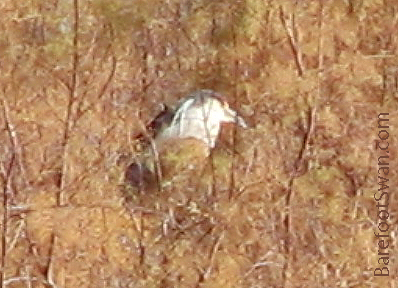

A distant Black-crowned Night Heron

Black-crowned Night-Herons are pretty common, but not always seen. They feed mainly at night and like to roost in trees.

Adults have a dark head and back, and long white neck plumes that you can just see in the photo. Up close you can see they have red eyes.

Great Blue Heron


This Great Blue Heron was roosting with its head and long neck tucked in against its body.

Great Blues are BIG - nearly 4 feet tall, with a 6 foot wingspan!

It's amazing that they can keep those long legs and toes from getting tangled up in the skinny branches.


Black Phoebe


Black Phoebes have sleek black plumage on the head, back, tail and chest, and a white belly. They look like they are dressed to go to a formal event.

They are flycatchers, and often hunt their insect prey from a favorite perch.


Bonaparte's Gull


At less than 14" long, Bonaparte's Gulls are noticeably smaller than the other common gulls. They are a winter visitor to our area.

During summer the breeding adult birds will have a black hood, instead of the winter "ear spot".


Black-necked Stilt


Black-necked Stilts definitely have an appropriate name. They are about 14" high, and most of that is their spindly, bright pink legs.

Males have glossy black markings, while the females and juveniles are browner.


The "sand" in front of this Stilt is actually made up of tiny barnacle shells. The barnacles likely arrived in the 1940's, via military sea planes and Navy vessels that were brought to the Naval Test Base at the southwest corner of the Salton Sea.

Barnacle "Sand"

And there were plenty of pelicans ...

American White Pelican


Pelicans are fish eaters, using their large bills and throat pouches to scoop fish from the water as they swim.

They do not dive after fish from the air, like Brown Pelicans.


With a length of over 5 feet and a 9 foot wingspan, the American White Pelican is the second largest bird in North America - second in size only to the California Condor.


After spending most of the day at the Salton Sea, we watched a colorful sunset over the water as we drove back home.


"A wonderful bird is the pelican,
His bill will hold more than his belican.
He can take in his beak
Enough food for a week
But I'm damned if I see how the helican."
~ 1910 limerick by Dixon Lanier Merritt
   (often attributed incorrectly to Ogden Nash)


For more information about the Salton Sea:

Sea and Desert Interpretive Association
www.seaanddesert.org

Salton Sea History Museum & Visitor Center
at the Desert Cahuilla Wetland
www.SaltonSeaMuseum.org

Salton Sea State Recreation Area (SRA)
www.parks.ca.gov/?page_id=639

Salton Sea Authority
http://www.saltonsea.ca.gov


Tuesday, January 15, 2013

Pine Cone Bird Feeders

Frozen water in the bird bath this morning

Winter here in our part of the Southern California desert is relatively mild compared to other parts of the country. In December and January our normal high is around 70 degrees, with overnight lows in the low- to mid-40's. Occasionally the temperatures head south, like the weather we're having now, with highs in the 50's and lows touching the freezing mark.

Birds that winter here are pretty fortunate. Natural food sources are available, and they don't have to forage in snow or brave blizzard conditions for a meal. We still like to provide healthy treats to supplement their diet. In addition to the seed feeders, suet feeders, fruit and jelly we put out, I decided to make some ever-popular Pine Cone Bird Feeders.

There is no lack of instructions on the internet for making these feeders. Most simply say (1) find a pine cone (2) spread peanut butter on the pine cone, (3) roll in bird seed, (4) tie a ribbon on for hanging, (5) you're good to go. But I wanted to try something that would be more appropriate for our desert climate, and would be less prone to melting when the weather returns to normal.

Peanut Butter, Lard, Corn Meal and Dried Mealworms

I found a slightly different recipe online, which combines equal parts vegetable shortening** (or alternative - see below) and oatmeal/cornmeal to make a stiffer mix for filling the pine cones.

I made a few changes to the instructions, and made 2 batches: one based on peanut butter and the other based on lard.


Pipe cleaners attached, ready to fill


I gathered these pine cones during a day trip last summer in the local mountains. They are small - about 4" high.

Make sure you select "open" pine cones, so there is plenty of room to slather on the filling.

Craft store pine cones are NOT recommended because they may have artificial coloring, scents or chemicals.

Most instructions say to tie a ribbon or string on the top of the pine cone for hanging. I opted for pipe cleaners, so they wouldn't get in the way when I filled the feeders.


Each bowl made enough to fill 2 small pine cones

Bowl #1
-- 1/2 cup Peanut Butter**
-- 1/2 cup Corn Meal

Bowl #2
-- 1/2 cup Lard
-- 1/2 cup Corn Meal

Mash together with fork until evenly blended.

** Generic peanut butter is fine, birds can't read labels.


Tarp the kitchen if you're doing this with kids.

Smoosh the filling onto the pine cone, filling in between the scales. I used the mixing forks, but you can also use a knife, small spatula or a popsicle stick.

I left the top and bottom of the pine cone un-filled, to give the birds a clean place to perch. In case birds worry about that kind of thing.

Two choices from the "Toppings Bar"

Online recipes normally show the pine cone feeders rolled in standard wild bird seed mix. I went with dried meal worms and safflower seed to finish them up.

Most cheaper wild bird seed mixes contains a lot of red milo which most birds don't care for, so it tends to get ignored and wasted. It also attracts House Sparrows.


If you were a bird, this would look pretty tasty


I used 1/4 cup of dried mealworms for 2 of the pine cones, and 1/4 cup of safflower seeds for the other 2. It was easier to pat the toppings on by hand, instead of rolling them in the bowl.


Here's how they turned out.

The safflower seeds and dried mealworms stuck fine to the filling.

The pipe cleaners stayed clean and out of the way.


Choose a location in your yard where you can watch the birds come to dine.
Wrap the pipe cleaner around the branch, then twist to secure.

It took about an hour for the first bird to try a nibble.
They were completely cleaned out by the next afternoon.

Here are some hints to consider:

-- Peanut butter is high in fat and protein. It is an excellent bird food.
-- Use lard or suet instead of peanut butter, in case of allergies (human).
-- Cold weather will help keep lard and peanut butter from spoiling outdoors.
-- Only put out enough suet/peanut butter to last for a day or two.
-- Put the filled pine cone feeder in the freezer to set, if needed.
-- If squirrels are a concern, hang the feeder with a long string or towards the end of a branch.
-- Use cut up dried fruit, chopped nuts or dried eggshells (rinsed well, dried and crumbled) as other toppings or mix into the filling.
-- We considered using unshelled sunflower seeds as a topping, but decided against it. The dropped shells would be pretty messy on the ground, covered with lard or peanut butter. Hulled sunflower seeds would be fine.

** There were a number of online recipes suggesting the use of Crisco, instead of lard or suet. Crisco is a hydrogenated fat and not generally recommended for bird consumption.
For an interesting discussion of this topic, check out http://www.bluebirdnut.com/the_fat_question.htm


"Everyone likes birds. What wild creature is more accessible to our eyes and ears, as close to us and everyone in the world, as universal as a bird?"
~ David Attenborough


Tuesday, December 25, 2012

Christmas Sunset


"When I admire the wonders of a sunset or the beauty of the moon,
my soul expands in the worship of the creator."
~Mohandas Gandhi


Sunday, December 23, 2012

Winter Solstice

At the time of Winter Solstice in the Northern Hemisphere, the sun's daily path across the sky has reached its furthest point south and its lowest altitude above the horizon. This occurs every year around December 21-22. The sun will slowly start to appear to head back north now, bringing us longer days and shorter nights.

The pic immediately below was taken at sunset, at the Winter Solstice. Compared to the other pics in our series, you can really see how far the sun's path has moved from North to South over the last 6 months. The palm trees are a bit taller, too ;-).

All pictures taken facing west.

Sunset at Winter Solstice - December 21, 2012

Sunset at Autumnal Equinox - September 22, 2012

Sunset at Summer Solstice - June 20, 2012

The time of Winter Solstice has been an important event in cultures throughout human history. Early astronomers watched the celestial movements of the sun, moon, planets and stars. They knew that Winter Solstice marked the seasonal end of long nights and the eventual return of longer, warmer days.

Many celebrations worldwide recognized the Winter Solstice as a time of rebirth, the victory of light over darkness, and the return of the sun. These celebrations often included the lighting of candles or bonfires, special songs and ceremonies, and much feasting with special foods for the occasion. Holiday traditions nowadays reflect many of these earlier practices. Our traditional Christmas celebration fits right in.


"I don't really celebrate Christmas. I celebrate Festivus."
~ George, on Seinfeld, "The Strike" (1997)


Sunday, November 25, 2012

Pushwalla Palms

Map of Hiking Trails at the CV Preserve


This past weekend we decided to burn some Thanksgiving calories with a hike to Pushwalla Palms.

Pushwalla Palms is one of a number of palm oases located in the Coachella Valley Preserve, in Thousand Palms, CA.


The weather was perfect for a day outside - highs in the low 80's and a beautiful blue sky.

In fact, the day was so gorgeous we decided to make a longer loop, by adding Hidden Palms and Horseshoe Palms to our hike.


Palm oases are leftovers from a time when our desert had a much wetter climate.

These particular oases are located along the infamous San Andreas Fault, which cuts through our Coachella Valley in a diagonal path from the Salton Sea through the Banning Pass.

At various points along the faultline groundwater reaches the surface, providing moisture that the palm trees need to survive.


Trail to Hidden Palms


Here are some pics from our hike.


Hidden Palms Oasis
Looking down on Pushwalla Palms


Trail down into Pushwalla Palms canyon


Groundwater reaches the surface, then sinks back into the sandy soil


The water also attracts butterflies, bees and dragonflies.

Butterflies drink water that has absorbed minerals and salt from the soil around it.
These nutrients are an important part of their diet.

When butterflies drink from shallow water like this, it is called "puddling".


Colorful Algae

The ripe palm fruits are an important food source for birds.

Owls often roost in the dried frond skirts of the palm trees. We found quite a few boluses, or owl pellets, at the foot of the palm trunks.

The pellet is the undigestible part of an owl's meal, which it coughs up. The pellet may contain fur, bones, claws, feathers, insect exoskeletons and other parts of the consumed prey. These parts have no nutritional value.

They do have scientific value, however. Researchers can collect, dry and sterilize the pellets before dissecting them to identify the contents.

They can then identify what the owl has fed on, and by extension what other animal species are living in the area.


Tuesday, October 30, 2012

"...Walk into My Parlor..."


It's almost Halloween.


In the spirit of the holiday, here are some cool pics of a spider living in our yard.


The markings on its abdomen are just beautiful.


He lives in our Milpa Garden.

The web was strung between the dried cornstalks.

He was eating a honeybee when we found him.


ANOTHER reason to not use pesticides...


"Will you walk into my parlor?" said the Spider to the Fly.
"'Tis the prettiest little parlor that ever you did spy.
The way into my parlor is up a winding stair,
And I've many curious things to show when you are there."

"Oh no, no," said the little Fly, "to ask me is in vain,
For who goes up your winding stair can ne'er come down again..."

~ Mary Howitt, English Poet  (1799-1888)
from her poem "The Spider and the Fly"


Sunday, September 30, 2012

More Volunteer Plants


A lot of the plants growing in our yard are volunteers - plants that self seeded or otherwise appeared on their own. These volunteer plants tend to do pretty well, since they "chose" their own location.


This is millet, which sprouted from spilled bird seed.


We have let it grow to provide natural (and free) food for the birds.


The seed heads can be left on the plant, or they can be cut and hung up at the bird feeding stations.


Kind of neat how the new seed head emerges from the stalk of the plant.


This green vine is probably a volunteer watermelon plant.

We planted a small patch of watermelons in this area of the yard last season.

It would be cool to get a second, spontaneous crop.

The vine is growing up a volunteer palm tree, which was "planted" by a visiting bird. 


"More in the garden grows
than what the gardener sows."
~ Spanish proverb